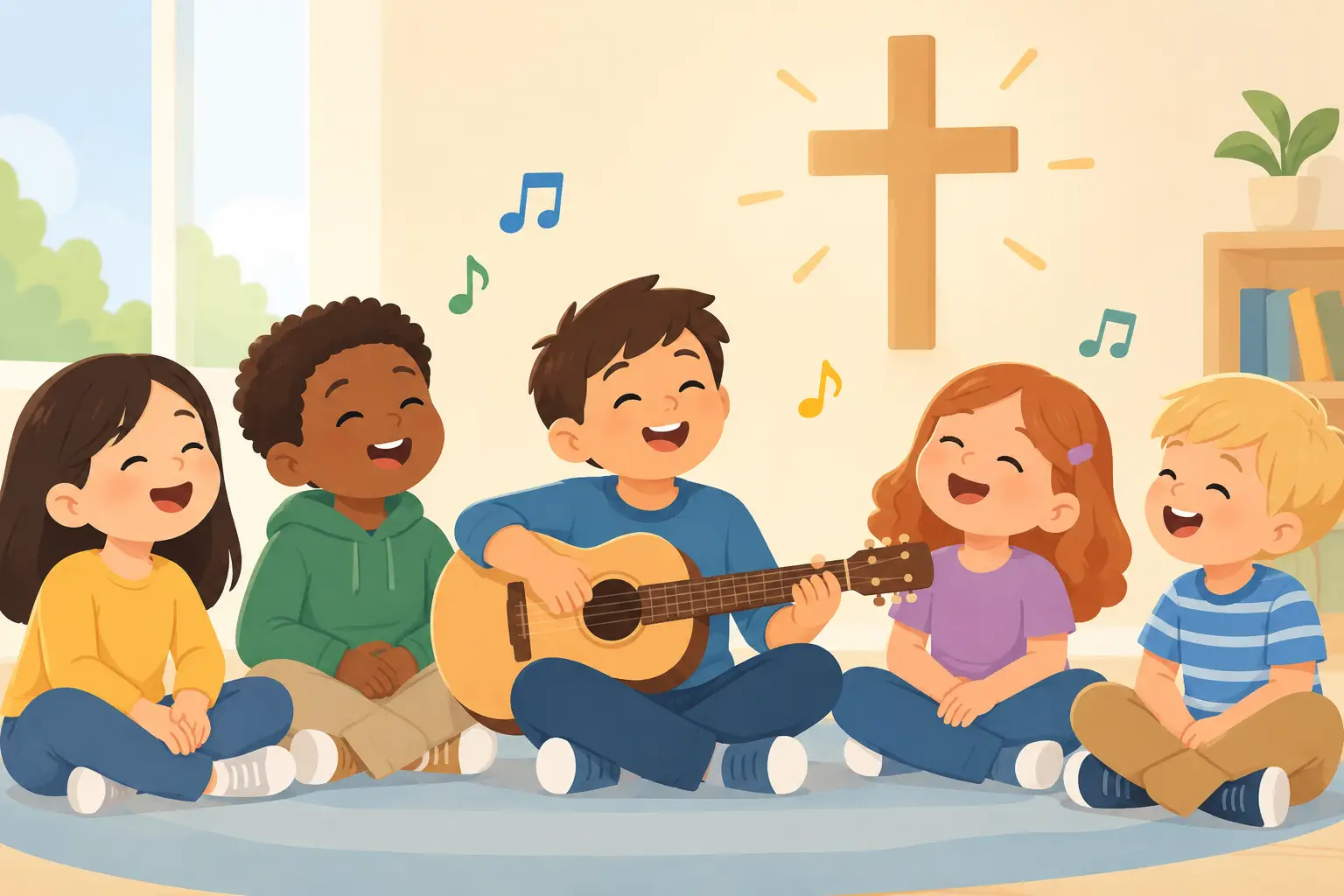
A child humming a chorus while buckling into the car may not look like a major spiritual moment. Yet faith based children’s songs often take root there – in the ordinary spaces between breakfast, school, bedtime, and Sunday morning. A simple melody can give a child language for gratitude, courage, forgiveness, and trust long before they can explain those ideas in grown-up terms.
That is why children deserve songs with both heart and craft. They do not need music that talks down to them, and they do not need a sermon squeezed into a rhyme. They need songs that tell the truth clearly, feel good to sing, and leave room for joy. When the lyric, melody, and message work together, a song can become part of a family’s shared memory for years.
Why Faith Based Children’s Songs Stay With Us
Children remember what they repeat. That is one reason music carries such influence. A verse may be heard once and forgotten, but a chorus with a clear idea and a strong melodic shape can return again and again. The repetition is not merely convenient. It gives children a way to rehearse faith in language they can hold onto.
The strongest songs do not try to explain every big question in three minutes. They choose one dependable truth: God is near, creation is a gift, we can choose kindness, Jesus brings hope, or prayer is always possible. A focused lyric gives children something solid rather than a pile of phrases that sound religious but never quite land.
This does not mean every song has to be quiet or gentle. A joyful rock rhythm, handclaps, a country-style groove, or a guitar-led singalong can all serve the message. Children respond to movement and personality. They can hear the difference between music made with real conviction and music assembled from familiar buzzwords.
Faith Based Children’s Songs Need a Child’s Ear
Writing for children requires respect for where they are. A child can understand wonder, fear, friendship, mistakes, and belonging with remarkable depth. But abstract language can lose them quickly. Phrases such as grace, redemption, and salvation carry rich meaning, yet a song should give those words a picture, a story, or an action that makes them understandable.
Keep the truth concrete
Instead of only saying that God is faithful, a lyric might describe being held steady in a stormy moment, finding strength after a hard day, or seeing God’s care in the morning light. Concrete images give a child something to imagine and sing. They also keep the song from feeling like a lesson sheet with a melody attached.
Bible stories are especially useful because they arrive with built-in action. David facing Goliath, Noah building an ark, Jesus calming the sea, Ruth choosing loyalty, or the good Samaritan stopping to help all offer emotional stakes a child can follow. The goal is not to retell every detail. It is to find the human heartbeat of the story and let the music carry it.
Give the chorus a job to do
The chorus is where children should be able to join in, even after a first listen. Short lines, familiar words, and a rhythm that feels natural in the mouth matter more than clever phrasing. If a child has to race through too many syllables, the message may be good but the song will be difficult to keep.
A memorable chorus often includes a repeated phrase, but repetition alone is not enough. It should move somewhere emotionally. It can rise into praise, answer a question from the verse, or offer a simple declaration of trust. The best refrains feel like a place everyone in the room can enter together.
The Difference Between Easy and Empty
Simple is not the same as shallow. In fact, writing simply is often harder. A songwriter has to remove extra language without removing meaning. Children can spot a forced rhyme, and adults who sing along will notice it too.
There is a useful trade-off here. A song may be packed with biblical references, but if the lyric is so dense that no child can sing it, its reach is limited. On the other hand, a chorus can be so general that it could fit almost any message. The sweet spot is plainspoken language with a clear biblical center.
For families and churches, it also helps when a song allows honest emotions. Faith is not only celebration. Children experience disappointment, worry, loneliness, and conflict. A song that acknowledges those feelings while pointing toward hope can be more helpful than one that insists every moment must sound cheerful. Hope has greater weight when it meets real life.
Let the Sound Carry the Message
Production choices shape how a child receives a song. An acoustic guitar can make a lyric feel close and conversational. A full band can turn a simple truth into a celebration. Hand percussion and group vocals invite participation, while a quieter arrangement may serve a prayerful bedtime song.
There is no single sound that makes music faithful. The musical style should serve the purpose of the song and the people singing it. A preschool group may need a steady beat and obvious cues. Older children may connect with a more current pop or rock sound that does not feel childish. A family listening at home may enjoy music with enough depth that parents want to hear it again.
That last point matters. Children’s music does not have to be disposable. Thoughtful guitar parts, strong melodies, and well-shaped arrangements honor young listeners without shutting out adults. Music can be accessible on the first listen and still reveal more warmth, detail, and meaning over time.
Where a Song Lives Beyond the Stage
A good children’s song should not depend on a polished performance to work. It should still hold up in a living room, a classroom, a car ride, or around a campfire. When a parent can sing the chorus without an instrument, the song has a life beyond the recording.
That is also why actions can help when they grow naturally from the lyric. Clapping, pointing upward, marching, or opening arms wide can give younger children a physical way to participate. But actions should support the song, not distract from it. Not every meaningful song needs choreography, especially when the lyric invites children to listen, reflect, or pray.
For worship leaders and teachers, consider the setting before selecting music. A high-energy opener can gather a noisy room, while a reflective song may better serve a closing prayer. At home, the need may be different: a song for anxious mornings, a thankful song before meals, or a steady reminder after a difficult day. The right choice depends on the moment.
Songs That Welcome the Whole Family
The most lasting faith-centered music makes space for children without treating parents, grandparents, teachers, or volunteers as an afterthought. A family song can carry a child through a season while giving adults words they need too. That shared experience is one of music’s quiet gifts.
It also calls for care in what the lyric promises. Songs should speak hope boldly, but they should not suggest that faith prevents every hard thing or that a child must feel happy all the time. Better songs point to God’s presence, love, and guidance in every kind of day. That is a message a child can grow into rather than grow out of.
At Capman Reign, original music is directed by a clear artistic vision, with songwriting and production serving the message rather than following a formula. For faith and children’s music alike, that independence matters. It leaves room for songs with real guitar, memorable hooks, Bible-rooted stories, and something honest to say.
A song may begin as a melody sung once at bedtime or a chorus played loud on a family drive. Give children words worth carrying. Years later, when they need courage, comfort, or a reason to praise, that small song may still be there.
Leave a Reply